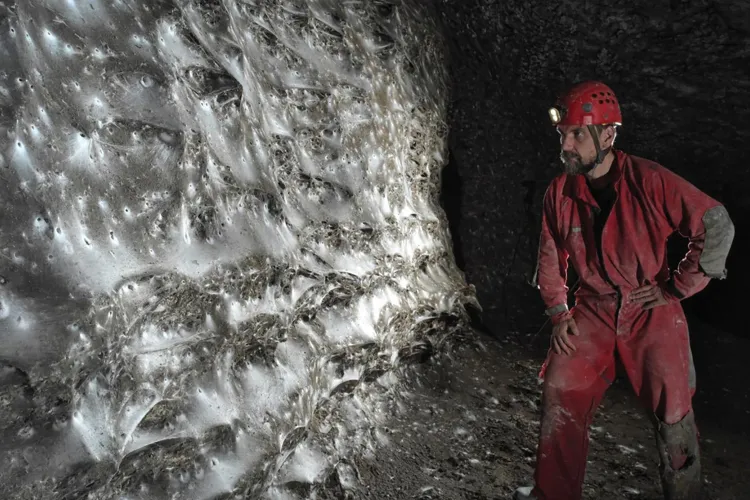
Spider Megacity Discovered in Sulfur Caves on Balkan Border
Deep beneath the earth, biologists have uncovered a living metropolis, but not one built by humans. Nestled within a network of sulfur-rich caves spanning the border of Albania and Greece, researchers have documented a complex, sprawling spider “megacity” unlike anything seen before in the natural world.
Unlike solitary web spinners, these cave-dwelling spiders have developed remarkable communal behaviors, weaving interconnected webs that stretch from floor to vaulted ceiling. Estimates put the population at over 111,000 individuals living in harmony, sustained by a constant supply of cave-adapted insects and a unique ecosystem created by high sulfur content. The web structure is so dense and tactile that scientists described it as “living architecture,” capable of transmitting vibrations across meters.
Expeditions have recorded rare social interactions: larger spiders policing violence, juniors rallying around egg sacs, and entire clusters collaborating to subdue larger prey. The colony’s existence is thought to hinge on the cave’s almost toxic chemistry—a cocktail of low oxygen and high sulfur—making it inhospitable to typical predator species.
Broader Implications
This extraordinary find challenges our understanding of spider sociality and adaptation, with researchers suggesting the site functions as a natural laboratory for evolutionary biology. Ethologists hypothesize that such communal living could emerge in many extreme environments, offering lessons in cooperation, survival, and even resilience under harsh conditions[$$97$$].